
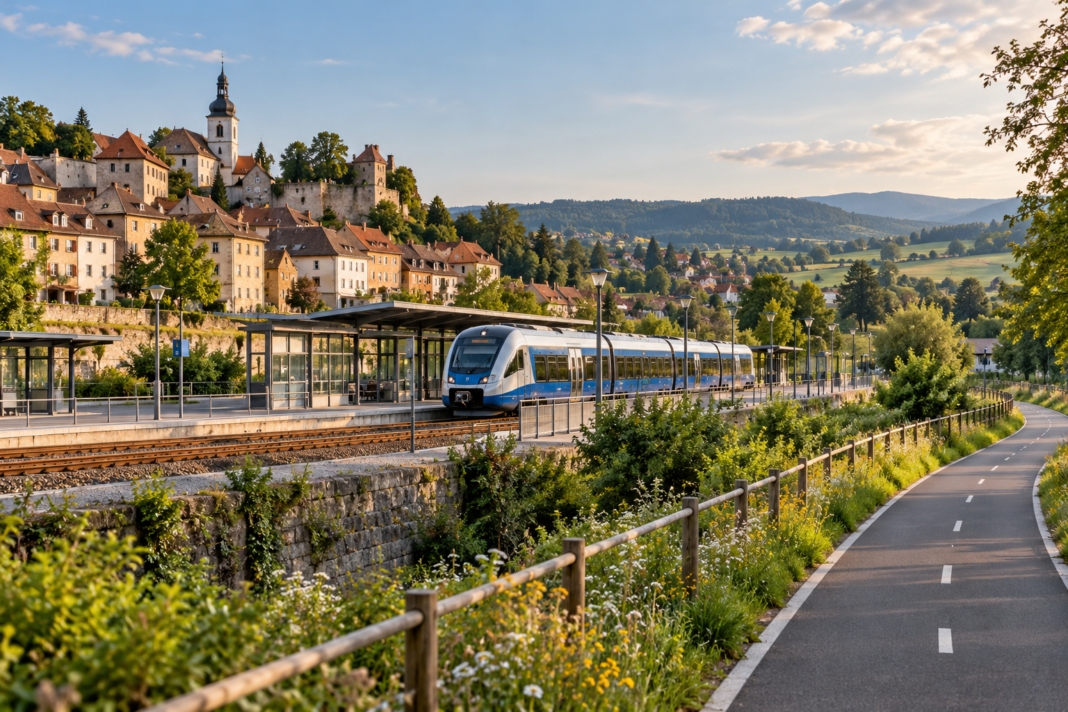
Regional development becomes easier to discuss when it starts with a place rather than a funding acronym. Can residents reach work, education and essential services? Can a small business find the people and connections it needs? These questions offer a way to examine what progress might mean beyond a capital city, while recognising that different communities face different constraints.
Start with the purpose of investment
The European Commission describes regional and urban policy as support for regions and cities across the EU, with cohesion policy seeking to reduce regional disparities. That broad purpose is a starting point for questions about a particular investment; it does not tell us whether an individual project has achieved its intended result.
A discussion can begin with a hypothetical town considering a new transport connection. What problem is it intended to solve? A shorter journey may matter to commuters, but the timetable, ticket price and distance to the station also shape whether residents can use it. Looking at the whole journey helps connect an investment proposal to daily experience.
Ask who can benefit in practice
A project can serve different groups in different ways. Young people seeking training, older residents accessing services and employers recruiting staff may have different priorities. Invite those perspectives into the conversation and ask what obstacles would remain after construction or launch.
Digital access raises similar questions. A connection is only part of a service if residents also need equipment, skills or support to use it. An online option can be valuable, but a discussion should also ask how people who cannot use it will be served. These are questions for project design and evaluation, rather than reasons to assume a particular result.
Separate delivery from outcomes
Completing a building, installing equipment or opening a route is a delivery milestone. Understanding its contribution requires another set of questions: Is it being used? By whom? What has changed for the intended users? Establishing a baseline before a project begins makes a later comparison more useful.
Presenters should ask which results are measured, over what period and against what starting point. A rise in activity after an investment does not automatically show that the investment caused all of it. Employment, population changes and wider economic conditions may also need examination. A clear explanation should distinguish observed changes from claims about their cause.
Keep the long term visible
A ribbon-cutting is a moment; a service needs maintenance, staff and operating resources. Who will be responsible for those tasks? How will residents report problems? What happens if demand differs from the initial forecast? These questions make the discussion more concrete without requiring agreement on every priority.
For the conversation: Which local service most affects your opportunities? What would you measure before declaring an investment successful? Whose experience is missing from the debate? Regional development can be examined through the everyday connections that allow a place to function.