Water resilience and community-scale renewal feature prominently in the 2026 New European Bauhaus prizes, which recognise projects combining sustainability, inclusion and design. The official awards platform confirms 13 prize winners and 20 recipients of the separate Boost for Small Municipalities initiative, announced at a ceremony on 15 October in Brussels.
The awards distinguish completed projects from concepts developed by younger applicants. The edition also includes a special water-resilience prize and international awards for projects in Japan and Brazil.
Water management becomes part of everyday design
Romania’s ECO H2O project in Viscri received the special water-resilience award, according to The Brussels Times. The project uses a nature-based wastewater system, linking infrastructure to the needs and setting of a rural community.
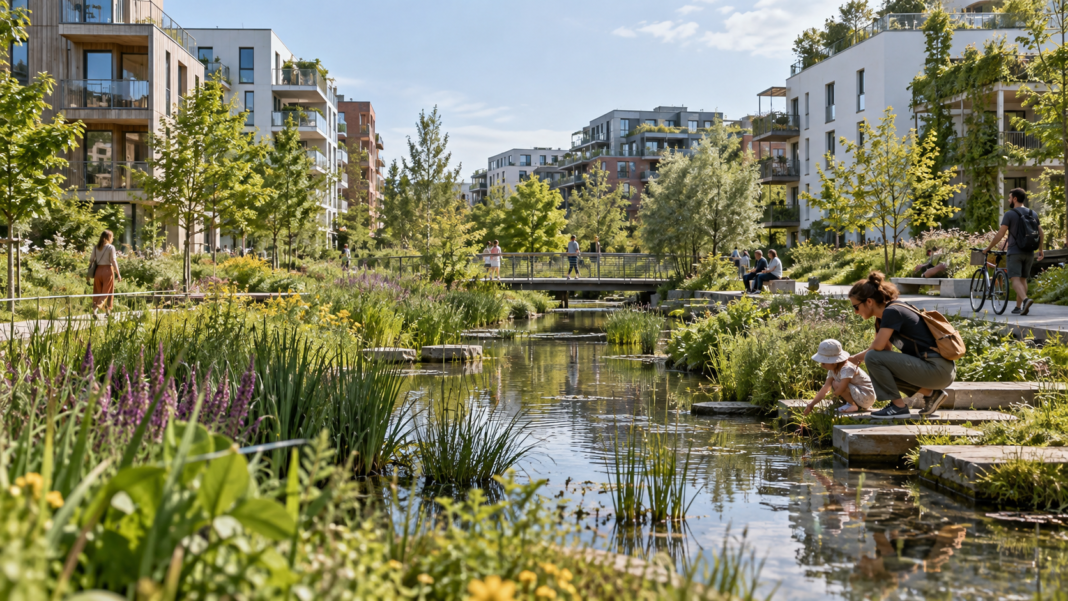
La Marjal Floodable Urban Park in Alicante, Spain, won the public vote in the Champions strand. Its use of wetland systems to absorb stormwater illustrates another way water management can be integrated into public space.
The projects address different problems: treating wastewater and managing excess rain are not interchangeable tasks. Their common feature is the use of landscape and natural processes as part of the infrastructure response, rather than treating design as something added after engineering decisions are made.
Awards support both completed work and emerging ideas
The competition rules set winners’ awards at €20,000 for Champions, the water-resilience prize and international prizes, and €15,000 for Rising Stars. Runners-up receive €5,000. Communication support, coaching and mentoring accompany the financial awards.
The reported winners also include a therapeutic garden in Ukraine, a Belgian project creating floating breeding platforms for waterbirds, and a circular-economy public complex in Kamikatsu, Japan. These are distinct local initiatives rather than a single standard design intended for every neighbourhood.
For municipalities considering similar work, that distinction is useful. Recognition can draw attention to a model, but its suitability elsewhere depends on local needs, operating arrangements and the people who use the space.
The Bauhaus approach joins environmental aims with accessibility and the quality of places. The 2026 winners show that the scale can range from a village wastewater system to an urban park, while delivery and long-term care remain specific to each community.