
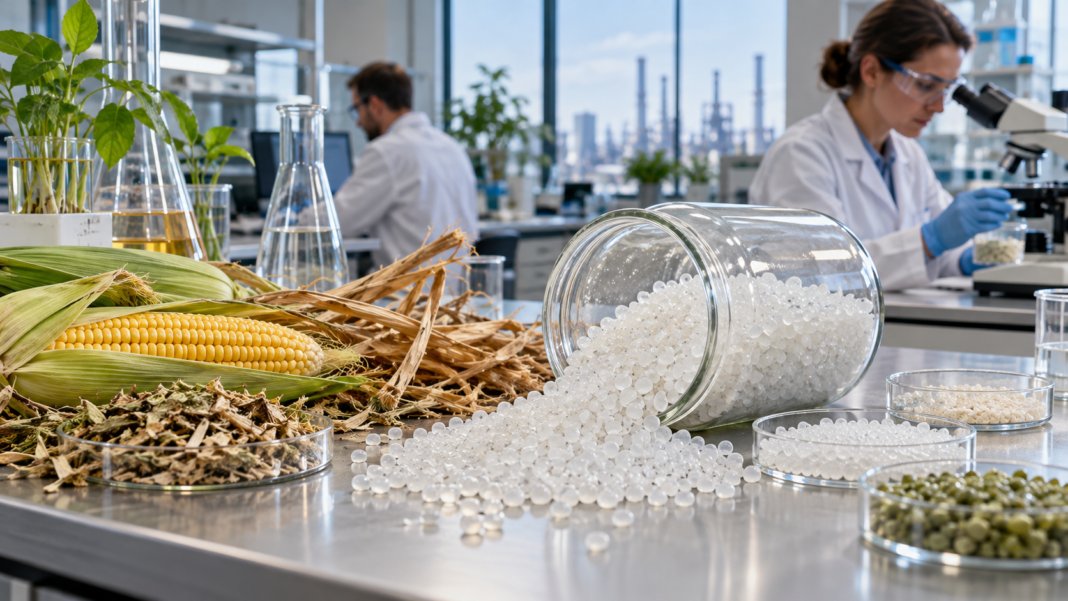
European projects making materials from plant sugars and urban waste are reaching an important stage: demonstrating that alternatives to fossil feedstocks can move from research into industrial production. Reporting by Horizon Magazine highlights facilities in the Netherlands and Spain, while researchers and companies identify scale, costs and markets as the next barriers.
The examples form part of a broader circular bioeconomy, in which biological resources and residual materials provide inputs for products. Their commercial prospects depend on more than showing that the underlying chemistry works.
Plant sugars supply a new polymer building block
Dutch company Avantium is developing PEF, or polyethylene furanoate, for uses including bottles, films and fibres. It relies on FDCA, a chemical building block produced from plant sugars.
The EU-backed PEFerence project supported an FDCA plant in Delfzijl designed for 5,000 tonnes a year. The company announced its first batch on 28 September, with commercial sales expected by year-end, according to the reporting. Those milestones should not be confused with evidence that the site is already operating continuously at its full annual design capacity.
Avantium’s public-affairs representative said the plant uses starch remaining from wheat processed for food protein. The project illustrates how an existing processing stream can become an input for a different industry.
Urban waste offers a separate production route
In Zaragoza, waste-management company Urbaser has developed a biorefinery using household organic waste and sewage sludge. Backed by CIRCULAR BIOCARBON, it is intended to produce materials including biopolymers, fertilisers, soil improvers and coatings, as described by The Brussels Times.
These two routes use different feedstocks and processes. Their inclusion under a common bioeconomy label does not make their products interchangeable. Nor does a plant-based origin alone establish how a finished item should be recycled or whether it can be composted: those claims require information about the particular material and disposal conditions.
Cost remains central to the industrial challenge. Researchers cited in the reporting say larger-scale production can improve efficiency, while regulation and cooperation between sectors can influence the route to market.
The immediate test is whether suppliers can deliver consistent materials at prices and volumes that customers can use. Demonstration products show what is possible; sustained production and demand will determine how widely the alternatives replace fossil-based inputs.